


Solar Water Pumps: Prices and Benefits in Kenya
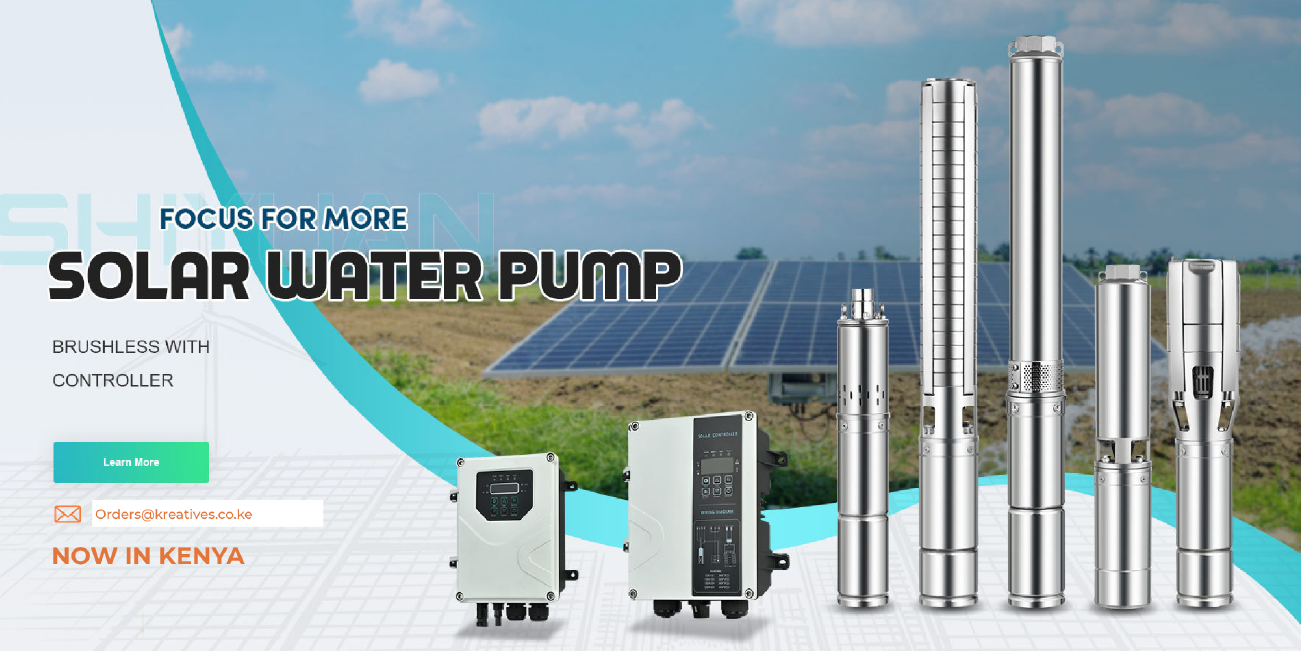
Solar Water Pumps in Kenya: How They Work, What They Cost, and When to Choose One
Solar pumps have become the default choice for boreholes and irrigation on Kenyan farms. Here is how to size one, what to expect from pricing, and how to fix the common problems.
A solar water pump is one of the highest-return investments a Kenyan farm or rural home can make. No diesel, no electricity bill, no fuel runs to town. The sun pumps water. But the sizing and selection process is different from a conventional pump, and getting it wrong means a system that underperforms every day.
How a Solar Water Pump Works
Solar panels generate DC electricity, which is fed to a solar pump controller (also called an MPPT controller or VFD). The controller converts the DC power and drives the pump — either a surface pump or a submersible borehole pump. Water is pumped to a storage tank, from which gravity or a booster pump feeds the irrigation system or the house.
The key insight: solar pumping is best done into a tank, not directly into a pressure system. The tank stores water, and you draw from it whenever you need it — even at night or on cloudy days.
Solar Pump vs Diesel Pump vs Electric Pump
| Aspect | Solar Pump | Diesel Pump | Electric Pump |
|---|---|---|---|
| Running cost | Zero (sun is free) | High — 1–3 L diesel/hour | KPLC tariff per kWh |
| Reliability | Very high, no fuel | Needs fuel, oil, service | Depends on grid reliability |
| Upfront cost | Higher (KSh 150,000+) | Moderate (KSh 55,000+) | Moderate |
| Best for | Daytime irrigation, boreholes | Remote sites, high-head pumping | Grid-connected sites |
What a Solar Pump System Costs in Kenya (2025)
| System | Typical Range | Best For |
|---|---|---|
| Small surface solar pump (up to 20m head) | KSh 35,000 – 90,000 | Small gardens, water transfer, shallow wells |
| Mid-range solar surface pump (25–50m head) | KSh 90,000 – 200,000 | Irrigation, small livestock, shallow boreholes |
| Submersible borehole pump (50–100m head) | KSh 180,000 – 400,000 | Domestic boreholes, larger farms |
| Deep borehole pump (100–200m head) | KSh 350,000 – 900,000+ | Deep boreholes, commercial farms, estates |
| Complete kit (pump + panels + controller) | KSh 90,000 – 1,200,000+ | Turnkey installation |
How to Size a Solar Pump Correctly
Two numbers determine the right pump:
- Total head (metres). The vertical lift from the water level to the discharge point, plus friction losses in the pipe. A good rule is to add 10–20% to the static height for friction, and 1 metre for every 10 metres of horizontal pipe run.
- Required daily volume (m³ or litres). Work out how much water you need per day, then divide by the number of peak-sun hours you have. In most of Kenya, plan for 4–6 peak-sun hours per day. A pump that must deliver 30,000 L/day therefore needs a flow rate of about 6–7 m³/h.
Always check the pump's flow-vs-head curve. The pump must deliver your flow rate at your head — not just at a lower head. This is the single most common sizing mistake.
Common Solar Pump Problems & Solutions
1. Pump doesn't run in the morning
Most likely causes: Insufficient irradiance (early morning is low-light), or a controller with a poor start-up threshold.
Fix: This is normal behaviour — solar pumps need full sun. If the pump runs briefly and stops even in good sun, check the controller's start-up voltage and the panel wiring for loose connections.
2. Pump runs but delivers less water than it used to
Most likely causes: Worn impeller, dirty panels, or a gradual drop in pumping depth (water table falling in dry season).
Fix: Clean panels first — dust and bird droppings can cost 20–30% of output. Next, check the water level in the borehole. Finally, consider impeller wear — see our water pump spare parts category.
3. Pump runs fine but no water comes out
Most likely causes: Air lock in the suction line, closed valve, or the pump is running dry (below water level).
Fix: Check the water level first. Then check the discharge valve. If the pump has a float switch, test it manually. For surface pumps, re-prime the suction line.
4. Controller shows a fault code
Most likely causes: Over-voltage, under-voltage, dry run, or over-temperature.
Fix: Note the code, then power the controller off and on. Dry-run faults usually mean the water level dropped — the pump will restart automatically once water returns. Persistent over-temperature faults indicate the pump is oversized for the head or under-ventilated.
5. Pump stops when a cloud passes
Most likely causes: Small panel array relative to pump size, or no MPPT tracking.
Fix: Add more panels to increase the array, or upgrade to an MPPT controller if the existing one is PWM. MPPT controllers are much better at extracting power in low light.
Frequently Asked Questions
Do I need batteries with a solar water pump?
No, not for most farm and borehole systems. The standard approach is to pump into a storage tank during the day and draw from the tank at night. This is cheaper and far more efficient than storing electricity in batteries.
Can a solar pump run at night?
Only if it is connected to a battery bank. Standard solar pumps run only in daylight. For night irrigation, use the stored water from a tank instead.
How long do solar panels last?
Quality panels have a 25-year performance warranty, with typical output of 80% of nameplate after 25 years. They need almost no maintenance beyond occasional cleaning.
What happens in the rainy season with no sun?
The pump runs less, but your tank should be sized to cover 2–3 days without pumping. If you need continuous water, a hybrid system (solar + grid, or solar + generator) is the answer.
Can I add a solar pump to an existing borehole?
Yes — most boreholes can be retrofitted with a solar submersible pump. The key checks are borehole diameter (to fit the pump) and the static water level and recharge rate.
Do solar pumps need a controller?
Yes — the controller is essential. It manages the pump's power, protects against dry running and over-voltage, and in MPPT designs extracts the maximum power from the panels.
What to Do Next
Send us your borehole depth, required daily water volume, and the height you need to pump to, and we will recommend a pump and panel size that fits your requirement.
Browse our solar water pump range, or our full water pumps range for conventional alternatives.
Not sure which part or model fits your setup? Send us your equipment or requirement and we'll point you in the right direction.
Prices and stock change - message us for today's rate and availability.
Recent Posts

Solar Water Heater Not Heating Properly? The Parts That Actually Fail
Solar Water Pump Losing Power or Not Pumping? 5 Spare Parts to Check
Car Wash Machine Losing Pressure or Leaking? The Spare Parts to Check

Commercial Oven, Mixer or Fryer Acting Up? What to Check Before Calling a Technician
Drip Irrigation Clogging or Uneven Flow? The Fixes That Actually Work
Why Your Water Pump Lost Pressure - And the 5 Spare Parts That Usually Fix It
Generator Won't Start? Run Through These 6 Spare Parts Before You Call a Technician