



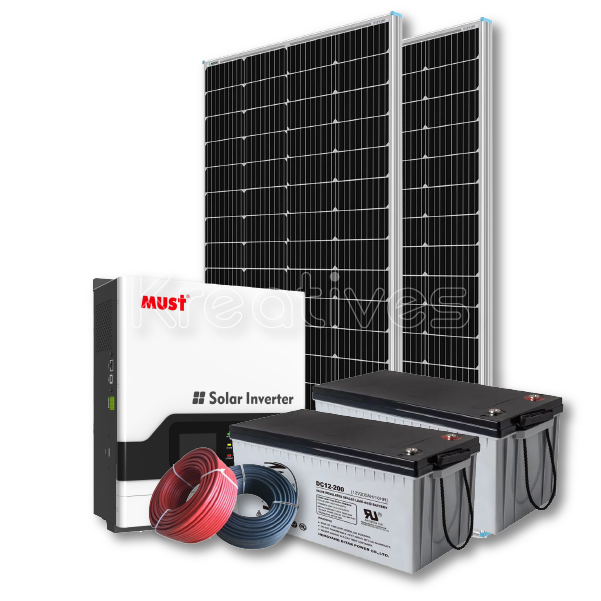
Solar Starter: How a Solar Panel Works (And How to Choose One in Kenya)
Everything a Kenyan homeowner needs to know before buying solar panels — how they work, what they cost, which brands are worth it, and the mistakes that cost people money.
What Is a Solar Panel, Really?
A solar panel is a device that collects sunlight and converts it into usable electricity. It is made of many smaller solar cells — usually cut from silicon — wired together inside a metal frame and covered with a sheet of toughened glass. A typical residential panel is around 1 metre wide and 1.6 to 2 metres tall, weighs 18–22 kg, and produces between 250W and 550W depending on the model.
When sunlight hits the silicon cells, it knocks electrons loose. Those electrons are pushed through an internal electric field created by the way the silicon is doped — one layer positively charged, one negatively charged. Metal contacts at the front and back of each cell collect the current and pass it out through the panel junction box.
That DC current then goes to an inverter, which converts it to the AC power your home appliances actually use. If you have batteries, they sit between the panels and the inverter, storing power for night-time use.
In short: sunlight → silicon cells → DC electricity → inverter → AC electricity → your sockets.
The Three Things That Actually Determine What a Panel Costs You
When you are shopping for solar panels in Kenya, every price you see comes down to these three factors. Understand them and you can evaluate any quote you are given.
1. Panel wattage (the headline number)
Panels are sold by their peak power output, measured in watts (W). A 300W panel produces 300 watts of DC power under standard test conditions — full midday sun, 25°C panel temperature, 1,000 W/m² of sunlight.
Real-world output in Kenya: you will get roughly 75–85% of the rated figure on a good day, because Kenyan rooftop temperatures run 45–60°C, and panels lose efficiency as they heat up. So a 300W panel typically delivers around 230–255W at peak.
2. Panel type (this is where most of the price difference lives)
| Type | Efficiency | Cost per Watt | Best For |
|---|---|---|---|
| Monocrystalline | 18–22% | KSh 45–65 | Home rooftops with limited space — highest output per square metre |
| Polycrystalline | 15–17% | KSh 38–52 | Larger roofs, budget-focused installs — lower cost, slightly bigger footprint |
| Thin-film / flexible | 10–13% | KSh 70–110 | Curved surfaces, mobile setups, off-grid caravans — niche use only |
For most Kenyan homes, monocrystalline is the right answer — the price gap over poly has narrowed sharply in the last two years, and the efficiency gain means fewer panels and less mounting hardware for the same output.
3. Brand and warranty
Panel brands sold in Kenya fall roughly into three tiers:
- Tier 1 (global): Canadian Solar, Jinko, Longi, Trina, JA Solar — 25-year performance warranty, 12-year product warranty, KEBS-imported. This is what we stock.
- Tier 2 (regional): Felicity, Must, Growatt panels — 10–15 year warranties, good value, widely available.
- Budget / unbranded: 1–3 year warranties, no clear performance guarantee. We do not sell these, and we would recommend avoiding them unless you are on a temporary setup.
Warranty matters more than price on panels. A panel is expected to produce 80% of its rated output at year 25. If the brand will not commit to that in writing, the cheaper panel is not cheaper — it is a 5-year panel sold as a 25-year one.
What Solar Panels Actually Cost in Kenya
Prices vary by capacity, brand, and whether you buy the panel alone or as part of a kit. Current ranges at Kreatives:
| System Size | Panels Needed | Panel-Only Cost | Full Kit with Inverter + Battery |
|---|---|---|---|
| 200W (basic backup) | 1 × 200W | KSh 9,500 – 14,000 | KSh 45,000 – 75,000 |
| 400W (small home) | 2 × 200W | KSh 18,000 – 26,000 | KSh 85,000 – 140,000 |
| 1kW (typical home) | 3 × 350W | KSh 42,000 – 62,000 | KSh 180,000 – 320,000 |
| 3kW (larger home / small business) | 6 × 500W | KSh 130,000 – 195,000 | KSh 480,000 – 850,000 |
| 5kW (business / heavy load) | 10 × 500W | KSh 210,000 – 320,000 | KSh 780,000 – 1,400,000 |
The number most people miss: the panels themselves are only 20–30% of a full system cost. The inverter, batteries, mounting, wiring, and installation make up the rest. A quote that focuses only on cheap panels is usually hiding the expensive parts.
How to Evaluate Any Solar Panel Before You Buy
When you are holding a quote in front of you, run through these checks in order. If a supplier cannot answer all of them clearly, walk away.
- What is the actual rated wattage — and at what test conditions? Panels sold in Kenya should be rated at STC (Standard Test Conditions: 1,000 W/m², 25°C, AM1.5 spectrum). Some suppliers quote NMOT or NOCT ratings instead, which are 20–30% lower — this makes their panel look cheaper per watt when it is not.
- What is the efficiency figure? Divide the panel wattage by its surface area in square metres and you get W/m². A 400W panel that measures 2 m² is 200 W/m² — good. A 400W panel that measures 2.6 m² is 154 W/m² — you are paying for a bigger panel to make the same power.
- Is the brand on the Tier 1 or Tier 2 list above? If the brand is not recognisable and does not have a Kenyan distributor behind it, warranty enforcement will be painful.
- What is the warranty term — and who honours it? Ask for the warranty document, not just the word warranty. A 25-year performance warranty means the panel must still produce 80% of its rated output at year 25. Anything less is marketing.
- Does the panel have a KEBS import mark? KEBS certification means the panel passed Kenyan import inspection for safety and quality. Panels without it are technically not legal to install on grid-tied systems.
- What is the actual physical size, and does it fit your roof? We have seen installs fail because the customer bought 8 large panels and only 6 fit the roof. Measure first, then buy.
The Three Mistakes That Cost Kenyan Homeowners Money
Mistake 1 — Buying panels before sizing the system. You cannot choose a panel until you know your total daily energy consumption in kWh. Every reputable supplier will ask for your KPLC bill (or a load calculation) before quoting. If they do not, they are guessing.
Mistake 2 — Under-buying the inverter. The inverter is the brain of the system, and it is where most cheap installs cut corners. A 1kW system with a 1kW inverter cannot actually deliver 1kW through it — inverter efficiency is typically 90–95%, and most inverters should not be run above 80% of rated capacity continuously. Buy an inverter 20–30% larger than your panel array peak output.
Mistake 3 — Skipping the battery, then wondering why bills did not drop. Solar panels without batteries only offset daytime consumption. If your home is empty 9am–5pm, you will export power you do not get paid for, and then buy expensive grid power all evening. A modest battery (5–10 kWh for a typical Kenyan home) makes the whole system actually pay for itself.
Frequently Asked Questions
How long do solar panels last? Tier 1 panels carry a 25-year performance warranty — meaning they will still produce 80% of their rated output at year 25. Realistically, panels keep producing for 30+ years with slowly declining output.
Do solar panels work on cloudy days? Yes, but at reduced output — typically 10–25% of clear-sky production. Kenya cloud cover is usually partial rather than total, so you will still get useful generation on most overcast days.
Do I need to clean my panels? In most of Kenya, yes — dust and pollen buildup can cut output by 5–15%. A soft brush and water every 4–8 weeks is enough. Do not use abrasive cleaners or high-pressure jets.
Can I install solar panels myself? Physically mounting panels is straightforward. The wiring, earthing, and inverter connection should be done by a qualified technician — both for safety and for warranty validity. Kenyan regulations also require licensed installers for grid-tied systems.
Will solar panels damage my roof? Not if installed properly. The mounting brackets are engineered to distribute weight and seal against water ingress. Poorly installed panels are the problem, not panels themselves. Ask for a waterproofing warranty as part of the install quote.
What happens at night? Without batteries, nothing — you draw from the grid as normal. With batteries, they discharge to power your evening loads. Most home systems are sized so that daytime generation covers daytime use, and battery storage covers 2–4 hours of evening critical loads.
What to Do Next
If you are at the start of a solar decision, the useful next step is not buy a panel — it is size the system.
Send us a recent KPLC bill (or tell us what you run — fridge, TV, lights, pump, iron, etc.) and we will come back with: what daily kWh you actually need, what panel wattage covers it, whether battery is worth it for your usage pattern, and a full itemised cost — panels, inverter, battery, mounting, install.
No obligation, no sales pressure. Just numbers you can compare against other quotes.